
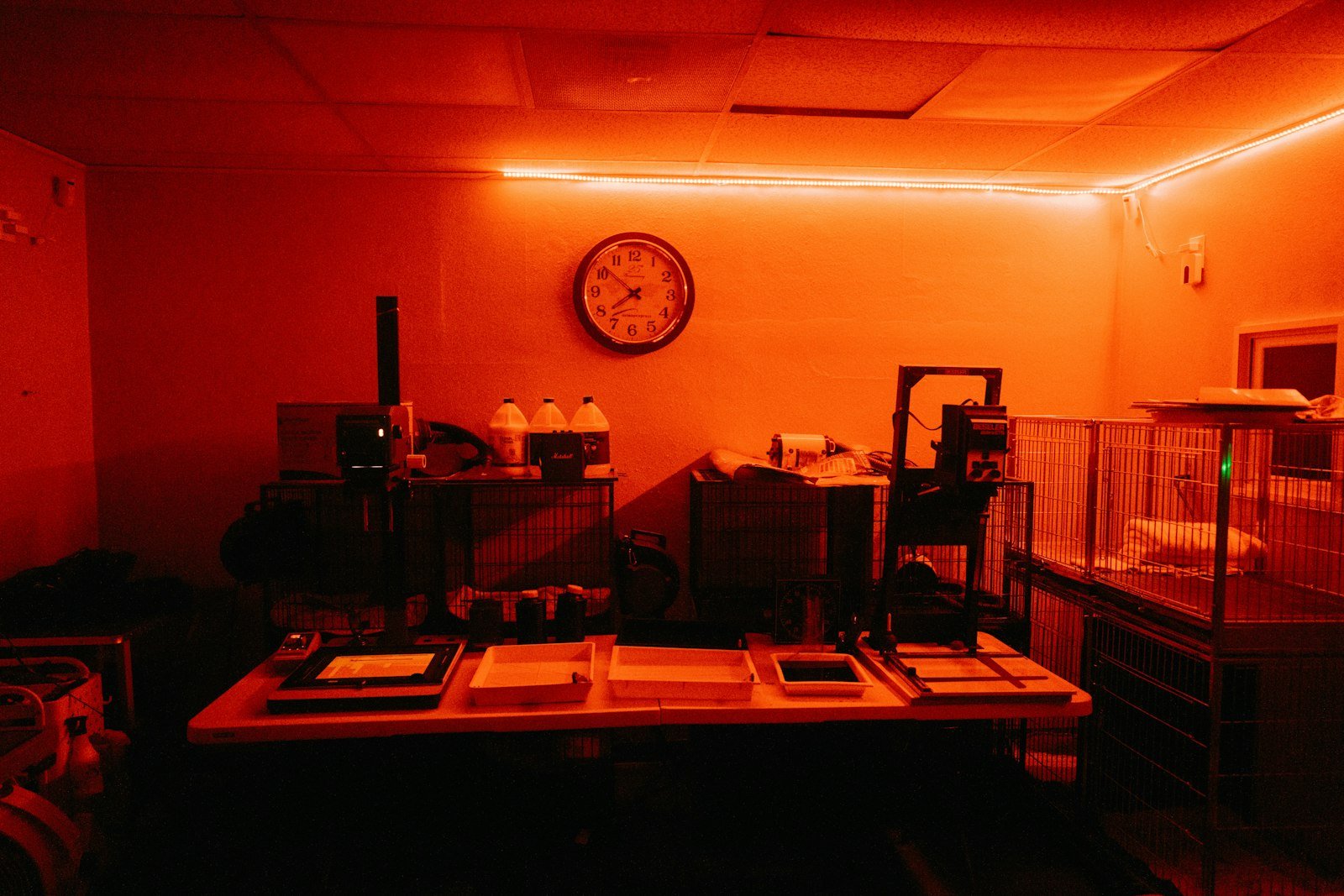
Who is this for? Film shooters who have sent a few rolls to a lab and want to develop black and white at home to save money and understand exposure. Journey time: 2 to 3 weeks.
1. Start with black and white only
Black and white chemistry works at room temperature (20°C / 68°F) and forgives small mistakes. Colour (C-41) needs 38°C held steady. Leave it for later.
2. Shoot a roll for the purpose
Ilford HP5 Plus or Kodak Tri-X 400, shot at box speed. Both are forgiving and every development chart lists them.
3. Buy the small kit
- Changing bag, developing tank with reels, thermometer, measuring jugs
- Film canister opener, scissors, two clips for drying
- Developer (Ilford Ilfosol 3 or Kodak HC-110), stop bath or plain water, fixer, wetting agent
Expect roughly $100 to $150 for everything. It pays for itself within a handful of rolls.
4. Practice loading the reel in daylight
Sacrifice an old or cheap roll. Load it five times with your eyes open, then with your eyes closed, then inside the bag. Kinked or overlapping film is the most common first-roll problem.
5. Look up your time and follow it exactly
The Massive Dev Chart (free website and app) lists times by film, developer and dilution. Check the temperature, mix the chemistry, set a timer. No improvising on roll one.
6. Run the sequence
- Develop, agitating as the developer’s instructions say
- Stop (about 30 to 60 seconds)
- Fix (check your fixer’s time, usually around 5 minutes)
- Wash, then wetting agent for 30 seconds
Ilford’s inversion wash method uses far less water than running the tap.
7. Dry, cut and sleeve
Hang the film somewhere dust-free; a bathroom after a hot shower works. Once dry, cut into strips of six frames and store in sleeves.
8. Read your negatives
- Thin, see-through frames: too little exposure
- Dark, dense frames: too much exposure
- Edge numbers visible but frames blank: a camera problem, not a development one
9. Handle chemistry responsibly
Used fixer contains silver. Do not pour it down the drain; check your town’s hazardous waste rules or ask a local lab. Wear gloves and keep the room ventilated.
You’re ready to begin. One roll, one kit, one evening. The second roll takes half the time.
Was this guide useful?
A rating takes one tap and helps the next beginner find their way here.